

Hardened Hearts and Praying Legs

Originally published on The Shabbat Drop by Miranda Lapides on January 23, 2026.
Last week, I had one of the most meaningful Shabbats I’ve had in a long time.
A small group of us at Base UWS had the privilege of hearing from Susannah Heschel, daughter of the late, great Rabbi Abraham Joshua Heschel.
For those who don’t know, Heschel was a beacon in the Civil Rights movement, famously having marched with Dr. Martin Luther King Jr. (yes, this is a belated MLK Day post), and really practicing what he preached. He emphasized that action was just as important as prayer, and that fighting injustice was a religious duty. He wrote at least a dozen successful and influential books, like The Sabbath and God in Search of Man. Heschel represented a kind of Judaism that was intellectual, spiritual, and deeply engaged with activism in the pursuit of justice.
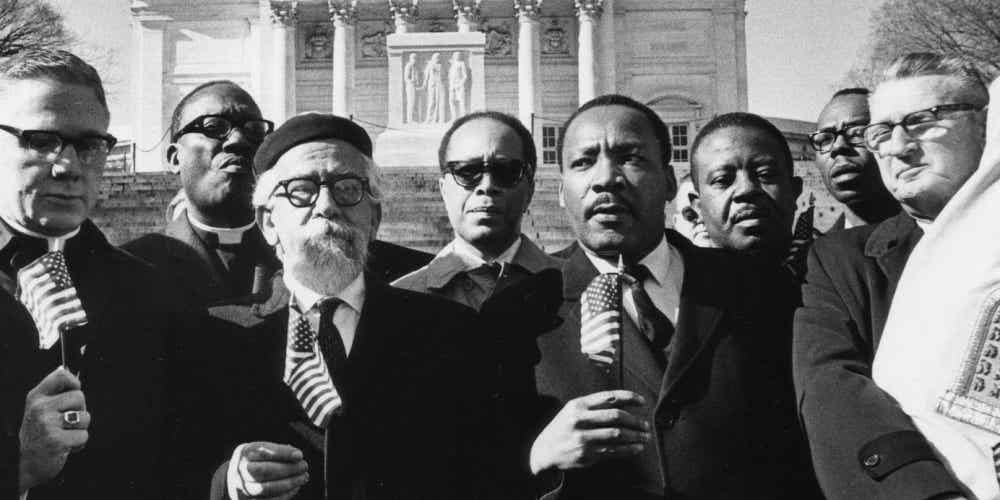
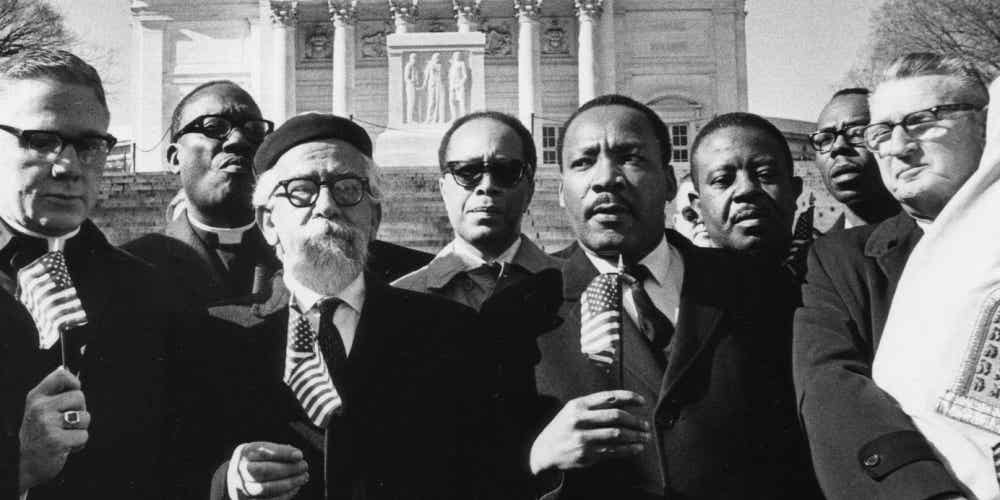
Heschel stands left of King in Montgomery, Alabama at the conclusion of the third and final Selma to Montgomery voting rights march on March 25, 1965. Heschel later famously said that march made it feel like “legs were praying.”
His daughter, Susannah, who was about 9 at the time of the aforementioned famous march, is a scholar and professor of Jewish studies at Dartmouth College. You can read a nice interview with her here about her father.
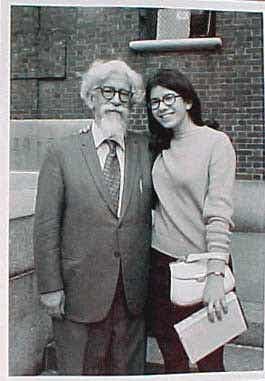
Susannah started off the evening by sharing her father’s history. Only having read one of his books (The Sabbath, obvy), I didn’t know too much about him other than he was a prominent scholar and theologian in the 20th century. I had no idea he was born in Warsaw in 1907, and only escaped Nazi Germany because he was one of five Jewish scholars selected for emergency American visas in 1939. He left for America just six weeks before the Nazis invaded Poland. His mother and sisters were murdered, despite him desperately trying to get them visas.
Susannah shared personal and heartwarming stories, shedding some light on who he was as a father and not just as a renowned rabbi. She also shared how it felt to be reintroduced by him to Dr. King as a little girl, and having Dr. King remember her.
In a round of questions from the audience, someone asked Susannah who she thought was a modern day Abraham Joshua Heschel within the Jewish world, fighting for justice and inspiring others to do the same just like he did.
She answered that while she could think of a few people, she encouraged all of us to see ourselves like her dad. We all have the capacity to embody those values he held so dear. One easy way is by showing up with kindness. She shared a story of how a few years ago, a man walking ahead of her dropped something. When she caught up with him to return the item he dropped, he thanked her with the biggest, warmest smile. It was so genuine, she hasn’t forgotten it years later. It’s so easy to treat people with warmth and dignity. We have this choice every single day.
And now, a word of Torah
Speaking of choice, there’s three parshiot when G-d hardens Pharaoh’s heart: last week’s parsha (Va’eira), this week’s parsha (Bo, a parsha that holds a special place in my heart, so to speak), and next week’s parsha (Beshalach). At first, G-d doesn’t do this to Pharaoh. In the first few plagues, it’s Pharaoh who hardens his own heart.
I always thought this meant he closed himself off to any pity he might feel for the Israelites, preventing him from freeing them. But then why would G-d later harden Pharaoh’s heart for him? Isn’t G-d just contributing to the problem of G-d’s own people not being free? Like those who complain about their problems, yet don’t do anything about them. We know the ones.
It’s not until the plague of boils that G-d hardens Pharaoh’s heart (Exodus 9:12), and continues this way for the rest of the plagues. With some research, I learned hardening a heart could mean Pharaoh made up his mind with his own free will at first. In plagues 1-5, Pharaoh chooses stubbornness, to not give in to G-d’s demand of freeing the slaves. So after the death of livestock (5th plague), G-d takes away Pharaoh’s ability to repent, teaching him that his choices have consequences. Except he’s so steeped in injustice, he’s not even teachable at this point. The great biblical scholar, Maimonides, agrees.
In Torah fashion, that’s just one interpretation!
Susannah taught us a different interpretation, from the Hasidic master Rabbi Levi Yitzchak of Berditchev. In his book of teachings, the Kedushat Levi, the Rabbi points out that the Hebrew root for heavy/hardened (כָּבֵד kaved) has the same root as the word for honor/dignity/glory (כָּבוֹד kavod).
Instead of G-d taking away Pharaoh’s will, G-d gives Pharaoh dignity and honor to make his own choices, however bad they may be. This reframing allows us to show compassion for our enemies, a very Hasidic thought.
At first, I liked this interpretation when I heard it from Susannah. But after reading Maimonides’s interpretation, I found it to be a little fluffy. It also didn’t sound very Jewish to me. After all, we tend to really not like our enemies. But that’s the beauty of Judaism: it’s a whole range of thought, ideas, and debates. Plus, I’m never one to doubt the persuasive power of similar Hebrew roots!
Neat side note: In my research, I found another interpretation that outweighs (pun intended) all the rest! You know how each plague corresponds to an Egyptian god (darkness defeats their sun god, Ra, etc.)? Apparently in Egyptian mythology, it was believed that the soul resided in the heart, and if your heart weighed less than a feather, your soul would live on in Aaru, the Field of Reeds. But if your heart weighed more than a feather, it would be devoured by the goddess Ammit (part lion, hippopotamus, and crocodile), and you would be condemned to live in Duat, the underworld. As we learned just above, G-d doesn’t just harden Pharaoh’s heart; he makes it heavy, condemning him to an eternity of hell. Which makes me react like this (G-d is the kid in the glasses):

Well, my friends, I was going to write about how after Susannah’s talk, I had a discussion with some friends about what dignity means to us. But my mind is kind of blown from the Torah and I need a minute (or 25 hours!) to recoup. In the words of Rabbi Heschel, “The higher goal of spiritual living is not to amass a wealth of information, but to face sacred moments,” (The Sabbath). It’s almost time to face our sacred moment.
Shabbat Shalom. Or as we say in Egyptian hell:
It don’t mean a thing, if it ain’t got that swing, Duat, Duat, Duat, Duat, Duat, Duat, Duat, Duat,

💦Related Drop
Kosher Duck Revolution is an initiative of AIC. Join AIC. Membership starts at $9 a month.