

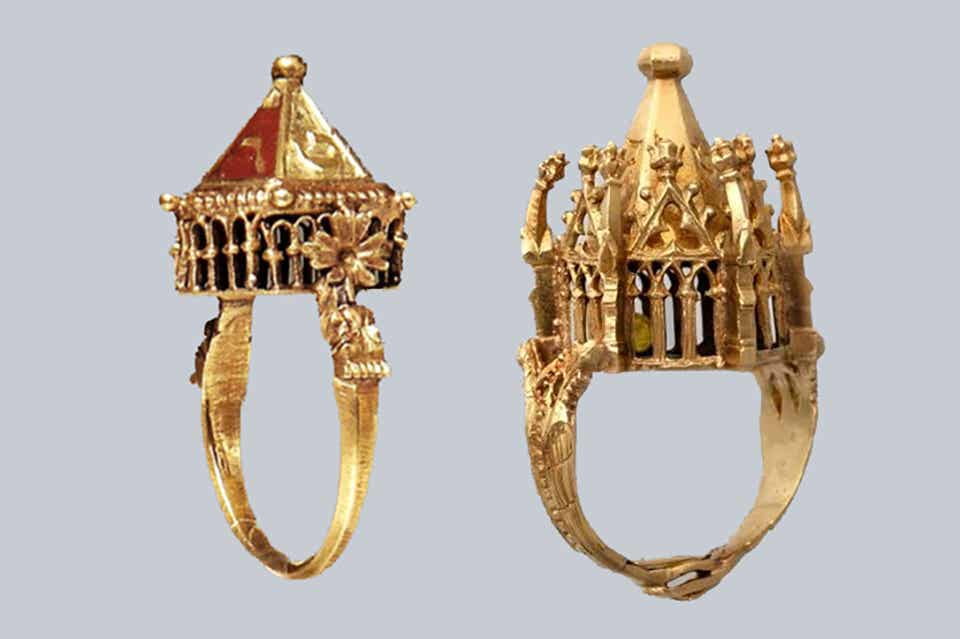
💍My Love for Medieval Jewish Wedding Rings

Originally published on The Shabbat Drop by Miranda Lapides on August 8, 2025.
💖 Help me reach my goal! 💖
Hi friends. My birthday is at the end of the month, and I’d love to celebrate my next follower milestone (because reaching 700 is way more exciting than turning 32). I have 68 more to go! Help me by sharing this Substack with someone you know who loves Jewish content! 🙏
Speaking of Jewish love… Tu B’Av starts tonight! It’s a minor holiday celebrating a major theme: love.
According to the Talmud, it’s when young women dressed in white and danced in the vineyards of ancient Israel, while young men came to choose a bride.
Now known as “the Jewish Valentine’s Day,” it’s common for people to propose or marry on this day. Aside from coupling up romantically, Tu B’Av is also about finding connection—with each other, or with yourself (I made the latter up, but I love self love!). During these challenging times, it’s always a good reason to dress up and connect with someone.
💕👉7 lovely activities you can do to commemorate Tu B’Av
Which brings me to a topic I’ve been wanting to write about for a while.
Years ago on a solo trip to London, I was exploring the V&A Museum, when I stumbled upon a shiny case of ornate rings. Each ring was shaped like a house. Taken by their gold and silver splendor, I read the plaque next to the case and was astonished to learn these rings had Jewish origins!
They were medieval Jewish wedding rings! During the 12th-15th centuries across Europe, Ashkenazi grooms would place an elaborate, oversized ring shaped like a tiny house on their bride’s index finger, symbolizing the home they would share together. Index finger so it’s easier for the crowd to see, and because it’s said that the index finger has direct connection via artery to the heart. Aw.
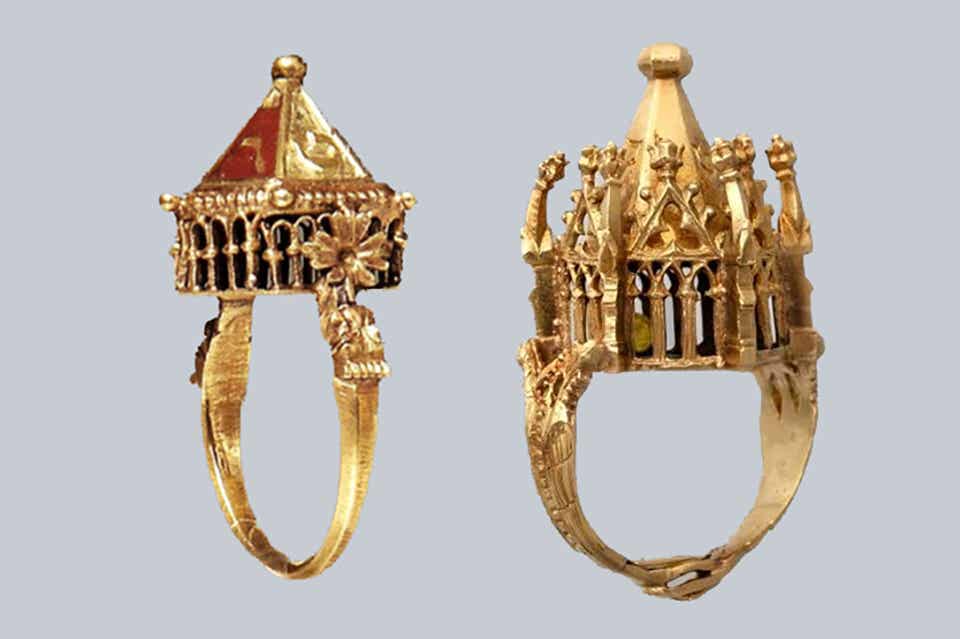
Medieval Jewish wedding rings from 14th century Germany. Note the two hands that clasp in the band. (source: Medieval.eu)
These rings were purely ceremonial, since most people back then were too poor to own wedding rings. These house rings were often communal, passed down and loaned out by the local synagogue. The Monopoly piece-like rings were too big to be worn all the time, anyway! Kinda gangster, though…
The rings were often inscribed with “mazal tov” to wish the happy couple good luck. Some opened like a locket. Some resembled the Temple in Jerusalem.
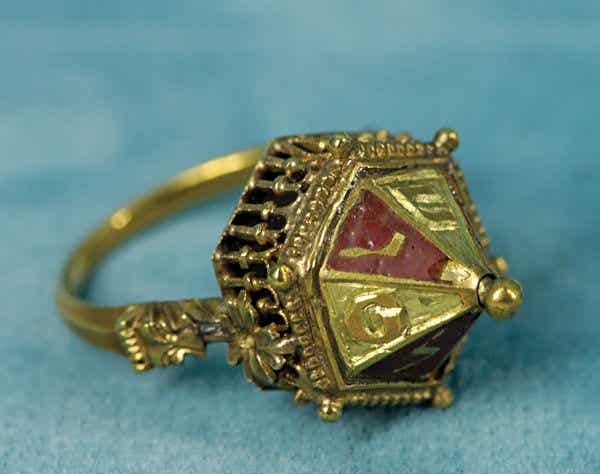
14th century ring from Alsace, France. Looks like a circus tent to me! (source: stljewishlight.org)
I love these traditional rings, not just because I have a fascination with antiquated Jewish traditions (priestly breastplate, I’m looking at you), and not just for their beauty. But they serve as a reminder that the home is the heart of a Jewish marriage. Unless you’re one of those annoying digital nomad van-life couples who never shower.
See more antique Jewish wedding rings here!
Is this your first time hearing about medieval Jewish wedding rings? Let me know in the comments!
📰 Shabbat Thoughts
Bringing back another old tradition where I used to share Jewish articles I enjoy. Here’s one on kashrut and identity:

The Wondering Jew
Why I Keep (Kinda) Kosher
A couple of years back, I was having dinner at a friend’s house. And he’d cooked a pork dish of some sort — pork shoulder, pork loin, really, it could have been pork anything. When I hear “pork” in a…
Read more
a year ago · 14 likes · 12 comments · Joshua Max Feldman
Shabbat Shalom. Connect with someone you love today,

P.S. Going on vacay mode for a bit. See you in a few weeks! ☀️
Kosher Duck Revolution is an initiative of AIC. Join AIC. Membership starts at $9 a month.